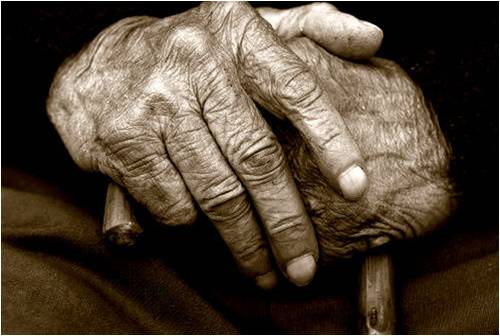
‘R was 92 and had previously held a driving licence. He walked slowly with the aid of a stick. He refused to use the ramp that was available and utilised by the other passengers when boarding and alighting the bus and he would not take the arm of Martyn (the driver) or others if it were offered. Despite having mobility problems he preferred the back seat of the bus and both drivers and passengers would wait until he had made his way up the steps to the back and was seated in his favourite spot. He was dressed smartly in a tweed jacket and flat cap. He rarely acknowledged other passengers although they sometimes made reference to him in their conversations so it was clear he was still a part of ‘the group’. Aside from when he spoke to me he did not interact with other passengers nor seemed to be engaged with the world outside the window. Instead he was continually lost in his own thoughts. One of the first things R explained to me was how his wife had died (it was not clear if this had occurred recently or not) his eyes filled with tears as he told me that he was alone and that she was no longer with him. He went on to say that the bus service and the lunch club he attended was his only contact with the outside world and that he would be lost without it. In the absence of the bus service he told me he would have ‘nothing’.
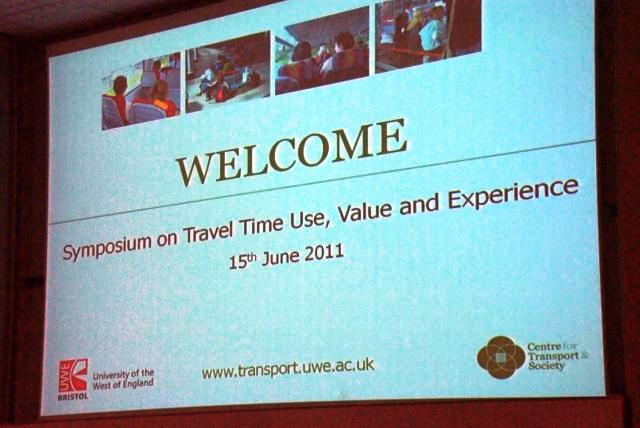
On the 15th of June, the Centre for Transport and Society Research at UWE hosted the first multi-disciplinary international symposium on travel time use, value and experience.
Over the last decade transport research has started to explore the ‘positive utility of travel time’, which has included new research methods for understanding how travel time is used. Simultaneously, the ‘passenger experience’ has emerged as a key theme in the social sciences’ ‘mobilities research’, developing theory around issues such as comfort and waiting.
The aim of the symposium was to present different disciplinary interpretations of travel time. It explored the tentative relationships between theories of travel time, the passenger experience, transport policy and economics, with the aim that through presentations and discussion we could explore opportunities for research synergy and consider how different approaches could inform and develop policy.
As a first year PhD student I’d submitted my abstract, without really believing it would have a strong chance of getting accepted. So it was something of a surprise to find a few weeks later I had been included in the line up. The diverse programme contained several ‘movers and shakers’ in the emerging area of travel time use, and it was a privilege to present some of my early stage findings alongside them. For me a highlight of the day was a fascinating presentation by Sarah Norgate (Uni of Salford) and Chris Speed (Edinburgh College of Art) entitled – If St. Augustine had had an i-phone: Multi-disciplinary Perspectives on Antecedents of Travel Time Use which constructed a narrative to reveal the stresses that contemporary networked communications are placing upon existing models of time. A second useful presentation (for me) was made by Tim Schwanen (University of Oxford) on Mobility and independence in later life and whose findings presented many similarities and thinking points with regards to my own.
In addition I think it was an invaluable opportunity for all in attendance to (re) consider the issue of travel time use from a multi-disciplinary perspective. It did get me thinking however that perhaps the greatest divides between us were related to questions of ontology rather than neccessarily being related to discipline. All in all it was a useful, inspiring and enjoyable day. Looking forward to the next travel time conference in 2013 in New Zealand!
Where are you going? – How will you get there? – Who will help you?
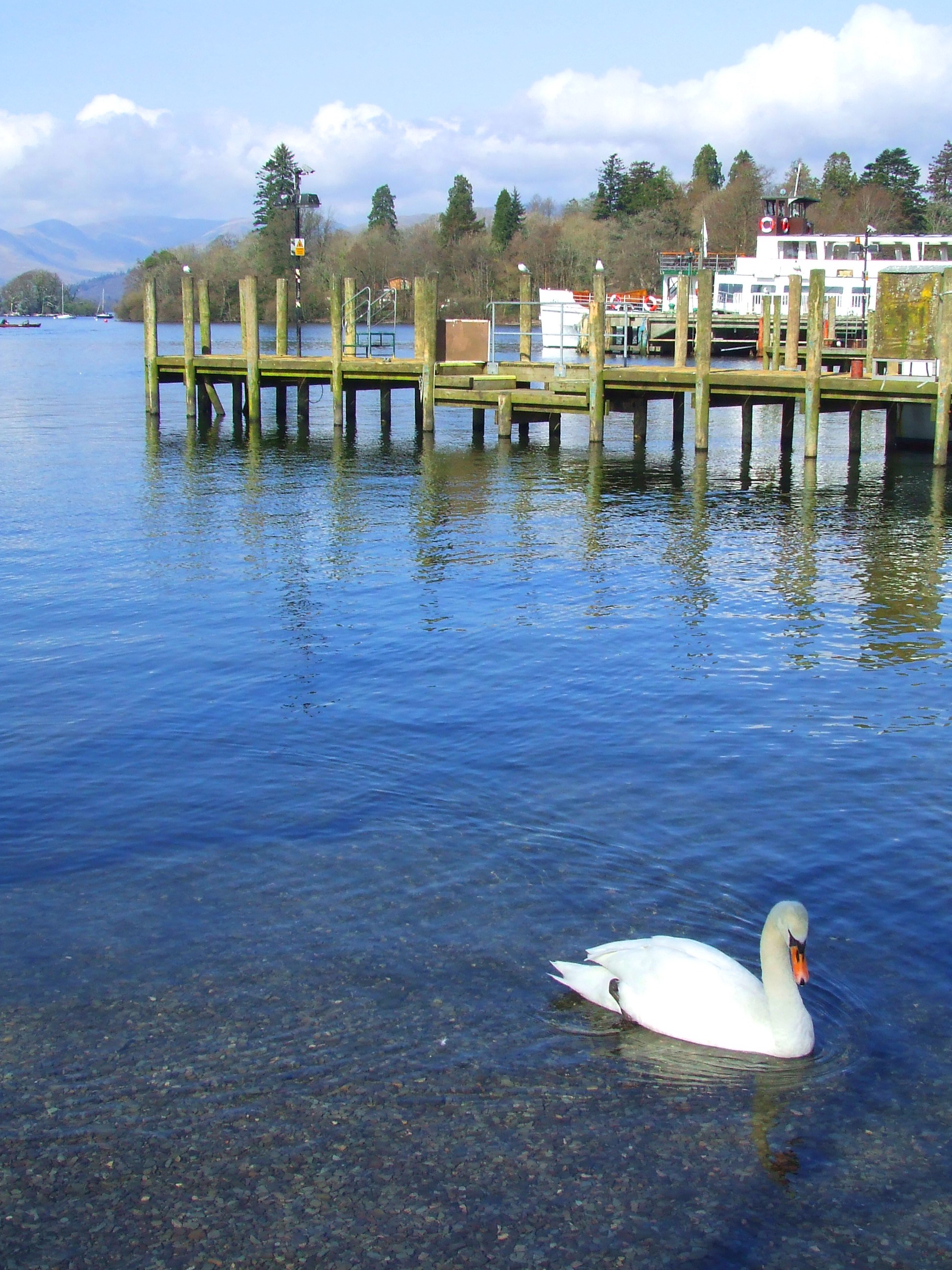
These are question we were asked at the culmination of an intense three days in Windermere, and what a three days it was. Twice a year a combination of 60 students and research staff at various stages in their careers and spanning all disciplines, are selected to attend the free residential leadership courses on offer by Vitae the research training council. This year I was privileged enough to be selected for this prestigious course and apprehensively made my way to the beautiful surrounds of Lake Windermere for what was a significant learning and existential experience.
Taking a ‘learning by doing approach’ the course was divided into seminars, practical workshops, and home group activities. Over the course of three days we were challenged to lead, reflect, learn, experience and work as a team. Whilst a variety of theoretical perspectives exist, a key emphasis of the course was experiential learning, and we were continually split up into changing teams and faced with various challenges. I ended up leading two tasks (one through delegation) these were managing multiple tasks and leading in a crisis. Multiple tasks was quite a challenge and we failed to achieve the full points. It was a little disheartening and the skills involved blindfolds, sculptures, quizzes etc etc.. Leading in a crisis was where I really felt I shone and we managed to perform well. We were assigned a buddy – often from a completely different background (mine was a middle aged, Chinese engineering professor from Oxford who had been sent on the course because he had poor relationships with his students) The buddy would then act as a ‘mirror’ and provide 360 degree feedback on performance and a sounding board for reflection.
A key learning point for the course was the power of failure. Most tasks were pretty difficult to achieve and through our efforts we encountered both obstacles and triumphs. We were advised we would both succeed and fail spectacularly. This was appropriate. This did show me that there were still things to be gained from situations that turned out badly, that it wasn’t how many times you failed but how many times you got up again.
In addition to the workshop we were assigned a home group task. In groups of six were assigned the challenge of delivering a fund raising initiative in just three days. We were given the sum of £100 and told to devise and initiate a campaign for a charity of our choice. All teams were to present on the final night, and were assessed against a range of criteria with a winning team being announced and prizes given.
I was lucky enough to have a great team, who worked hard to get our idea up and running. Having been assigned the team leadership role I was extremely proud three days later when our idea: Webber’s Windermere Womble’s – we were raising money for the organisation shelterbox, and won the challenge overall out of ten other teams, (with the help of some litter picking efforts and the use of social media) Whilst we didn’t reach our target the sum of £320.00 in less than three days was a good effort and the highest total overall, and our concept made a contribution to both local and global needs.
I signed up for the course I guess because I was never sure if I had the power to lead others. Somehow I often ended up sort of leading people, but I had never really pushed myself forward consciously. The course was an intense, challenging and exhausting three days. However I learnt a lot about myself. The feedback helped me to learn that sometimes I know what’s in my head, but other people sometimes don’t. It taught me to try and draw on others and trust people rather than always doing things myself. It also taught me that in teams people have different needs and not everyone responds well to my creative, energetic autonomous approach to leadership if they are happier with security, certainty and direct instructions.
It also showed me that there are lots of things about me that make me an effective leader. Like the ability to motivate and inspire others, to support and energise, to see the bigger contextual picture and to supply vision. Luckily I had people in my team with opposite skills to my own which is also what made us so successful I think. Fundamentally, and perhaps most significantly the course taught me about the power of collaboration. We were from different backgrounds, perspective, experiences, and often cultures. Yet we came together and achieved. That was probably the biggest lesson. Our team didn’t spend our start up money yet through teamwork we managed to create and succeed with our existing resources – people.
There a lot of people who are often closed minded to this sort of approach – workshops, integration, random tasks. It requires faith, trust and buy-in to get anything back from it, but if you do I’m sure you will think its worth it. In fact it was a challenge in the first few days to convince my buddy professor to listen to me. He spoke often of how stupid his students were and how he was frustrated with them. After three days with me.. (stop sniggering at the back) he actually began to reconsider the ‘youth’ of today in a different light..to think differently, and to appreciate the person behind the ‘student’ role. In turn he taught me that whilst being ‘old skool’ there was a lot of wisdom, commitments and dedication behind the communication struggles. He was a gentler person. So was I. Once the course was complete I took a few days in the beautiful lakes to reflect on the experience. The Wombles have since disbanded but I’m still in touch with a few of them.
So, three months down the line is the experience still with me? I think yes. The course taught me that I have leadership potential, but that I won’t get there on my own. I’ve been increasingly thinking about the possibility of social enterprise, and this is not something I would have had the confidence to consider before the course. It made me realise that my pre-occupation with the potential for failure actually often prevents me from achieving or producing things. Most importantly, however my PhD works out, I think the principles we learnt on the course are transferable enough to benefit multiple aspects of my life. Being a PhD student is not just about writing and defending a thesis. The course should me how much potential all of us had to lead inspire, achieve and support each other and to achieve for the good of society regardless of our disciplines.
It made me proud of the people that I met, and proud to also be one of them. One of the best experiences of my university career for sure.
In January I bravely signed up for ’Writing on the Body’ . Led by Dr Barbara Bridger from Dartington College of Arts, a two day workshop at the Arnolfini. I’m from a social science/studies background, and I was curious to understand what the arts could offer in terms of cultural theory and interpretation of this notion of ‘the body’. I’d previously studied as part of my first degree the sociology of the body and I was interested in thinking about ageing bodies is in relation to my research. I was hopeful that the course would perhaps stimulate my thinking in a different way. So. Being brave. I wandered quite naively into the room ever the optimist.
There was some background theory – some basic Derrida which was great and a reminder of how despite how disciplinary boundaries may be defined – fundamentally the thoughts and thinking of key theorists along with political, social and cultural changes often permeate the teachings of both the social sciences and the humanities. Although there may be some way to go before philosophy dribbles into the teachings of pure science though? Or maybe not?
It was a good workshop. Scary but good. I was introduced to a range of textual practises and ways of writing for the body. To be fair I hadn’t anticipated the amount of practical work we were expected to do. This element was totally new to me. Not being an artist or at least not being anything like one for a number of years I was totally unprepared for the level of self exposure (maybe not the right word – maybe self expression) that the practical element expected. Suggested practical tasks were things such as: photographing your body and using post it notes to tell a story of you (such as scarred bodies), writing the story of a body part on a piece of paper and burning it, or making an artwork using your own bodily fluids (the tutor re-laid a story of one of her former students cutting herself during a performance. We were not specifically encouraged to do this but I got the distinct impression that the tutor sort of maybe felt that the student concerned was within her rights to do so. Interestingly I had also heard a rumour through drama students at my current university that a similar thing had occurred during a performance for an avant-garde module, and the result being the performance was stopped. This raised an interesting ethical dilemma for me, I have not seen enough theatre to comment on any specific performance but in terms of pedagogy – where do you draw the line?
The body is a form of expression not just in performance but in everyday life – through the embodiment of physical actions with signifying meanings, through conscious self expression or display (tattoos, hair dye, piercings, cosmetic surgery etc) and the ongoing societal struggle and scientific quest to halt or delay the ageing process. Bodies are places of struggle, they are canvases and are often key signifiers to others of our place in society – disabled bodies for instance. What is *normal* v’s what is *different* what is our attitude to live bodies vs dead bodies? Where does the person end and the body begin? What is viewed as more preferable old body or a young body? Why?
We also go the opportunity to look around the exhibition on the same theme which had some breathtaking exhibits, which certainly made you think about the body in a different way. It was a great experience for me to go round in a group and discuss responses to the pieces as I I’ve often no idea really (or felt a little bit of a luddite) sometimes around visual modern art. I’m getting there (I seem to be better with sculpture than paintings in this respect).
What I did notice sadly though was the absence of ageing related exhibits, examples and theory in both the literature, the workshop and the exhibition/examples we were shown. So whilst this issue of the body appears to be alive and well in sociology and the arts, the issue of ageing has yet to be explored or represented thoroughly perhaps in both disciplines.. and ageing and transport? Nonexistent.
I’ll give it a go.
I didn’t get around to producing any practical pieces, and I was unable to attend the second day as I had a rehearsal. I was also really rather glad of this, to be honest I was terrified. But perhaps I will revisit that list at some point. I have had a few ideas since then (mainly relating to the commodification of the body) that I could explore.
Another thing that struck me was how overwhelmingly introverted or (can I say it) navel gazing I felt it was… I guess my attitude has always been that any inner turmoil is (was) what it is, but there is always a worthier story to tell than mine. A bigger cause than any anecdote about my own suffering. Perhaps I just wasn’t angry enough? Take Tracy Emin. She has suffered. She has produced some great art. But blimey O’Riley sometimes I just think ‘get over it’. Perhaps the subject is not her. I sort of think it is though? It seems epistemological (subject/object?) debates are central perhaps to artistic production and interpretation just as they are in qualitative research.
Similarly my in research, there are some authors who, using ethnography, have endeavoured to reveal the nature of transport spaces through observations, but ultimately what I hear in the final write up is the voice of the researcher, not the observed. Is it not more powerful to give voices to others to enable them to tell their own stories? I don’t know enough about art or performance yet to answer these questions (both why and how) but at least for research to a greater degree as possible, the story is about them, facilitated by me. I will never be able to truly understand the meanings associated with older people’s experiences and how these experiences affect and impact on them both physically and psychologically, but I can attempt to find a way to reveal the stories of the people I meet if it is simply not possible to empower them to tell their own.
Okay so this is all a bit experimental.. I enjoy collage, photography, and other art things but fine art I am a complete novice at.. its all a bit of a learning process.. Most of my efforts go into photography and I hope to launch a dedicated website in January of 2012 so a good deal of my photos will be availiable then, to view and buy. In addition I’m becoming increasingly interested in the potential of video and moving image as forms of creative expression, documentary and idea dissemination. However I decided to branch out recently in a painting day for my birthday treat for myself
Here are the (best) fruits of my labour and a few other arty type things I’ve got up to recently..
Painting
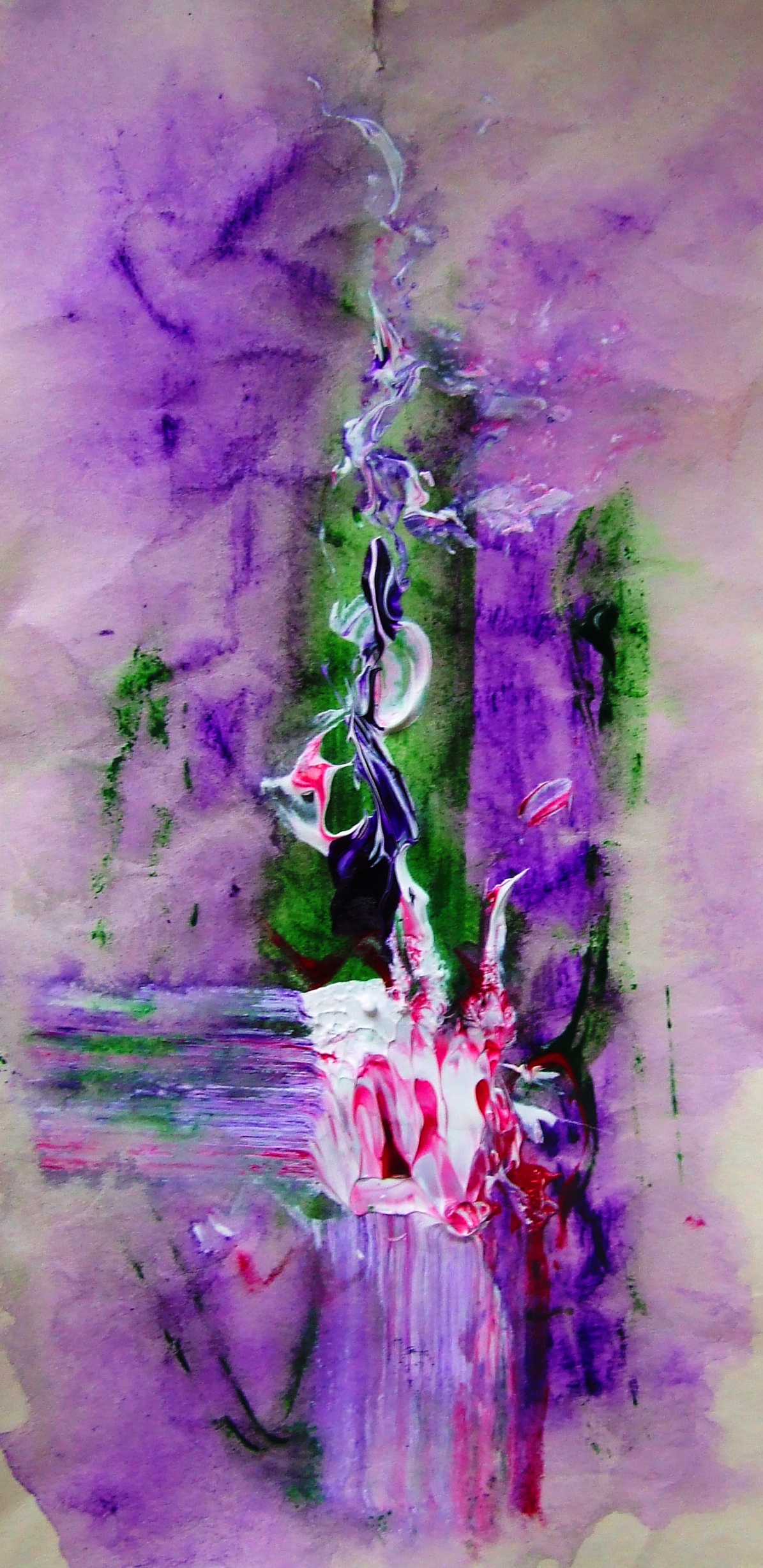
The paintings below I produced whilst messing about recently on a introduction to painting course at the Folk House in Bristol. My basic strategy was just to create something and try to work out what it all meant after.. the meanings are there but I found it doesn’t help for me to think about them consciously.. not sure if that is common in art or not.. It was very daunting to walk into what felt like a classroom for the first time in years and pretty scary to be given a range of blank sheets to work with. The course was reasonably flexible and we could more or less interpret things in the way that we wanted.. I struggled a bit with my total lack of drawing ability but found I am much more comfortable using colour and texture. In the end it was a great birthday!
Entitled: The Patriotic City
Another effort…
Entitled: Lotus Flower
Published Photography
Realised I took the below photo in 2009 and it has recently been featured in the book Bandstands by Paul Rabbits.
Entitled: Clapham Common in snow
Collage
The below is a collage I put together to assist in songwriting, for a course I took at Artist Studio’s Bristol earlier in the year (the collage is much better than the song turned out to be). I am currently about to start work on another collage piece called ‘The Commute: parts 1 and 2’ which are based on, and in response to a poem I read recently.









 Amy-Louise Webber