Art

Dreams, memories and the wisdom of children – Life Savings at the Eggstinov, Bath

I’d sort of already decided that this was going to be good. So I should probably declare a slight bias now. (I’m not a reviewer or a critic and I never buy programmes)

So what in particular did I enjoy about the performance?

The sound of writing, boxes of dreams, the fragility of children’s hopes, of seeing the world through their eyes, the exuberance, optimism, anxiety, honesty of youth, memories, (forwards, backwards) a melodic lullaby in a garden den, the simplicity of a world where people say what they think, a waterfight, an uncanny wisdom contained within small bodies, remembering, forgetting, laughter, fearlessness, joy, a change of space, a change of time, (forwards, backwards)  boxes of memories, life changing experiences, remembering, forgetting, small moments, precious things, (forwards, backwards) painful happiness, exquisite sadness, four essays and some pro-plus, the change the snow brought, a New York marathon, love (almost) in a baguette shop, heart surgery, a ticking stopwatch..

You see there are times…. when memories….. well they become so wrinkled that you can pierce through them.. Sometimes, in special moments – you get the opportunity…….  to look both forward and back…..

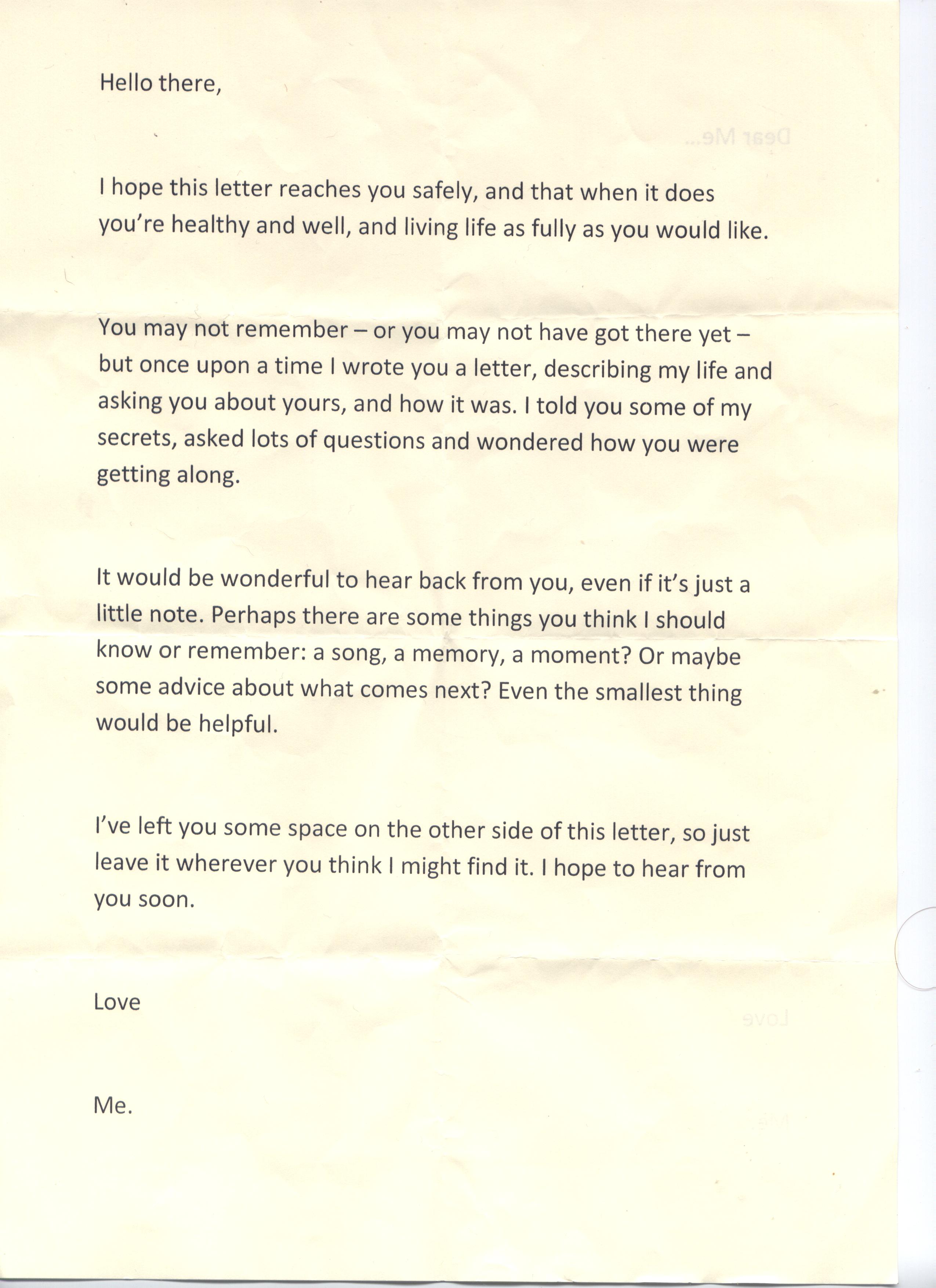
A letter from my past or maybe from the future (forwards, backwards, forgotton now remembering), and a theatre which fitted the small people perfectly.

I’ll answer the letter soon of course.  I’ll post my reflections here.

Life savings was a work of art and a privilege to experience. Thank you to everyone who bravely shared their stories. I loved them all. I think however, that for me its the kids that stole the show.

Oh, and be sure to let me know the final count of how many lives you saved..

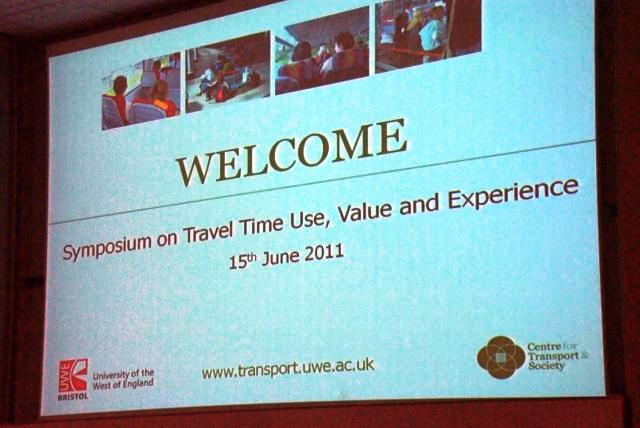
International symposium on travel time use, value and experience, Centre for Transport and Society, UWE

On the 15th of June, the Centre for Transport and Society Research at UWE hosted the first multi-disciplinary international symposium on travel time use, value and experience.

Over the last decade transport research has started to explore the ‘positive utility of travel time’, which has included new research methods for understanding how travel time is used. Simultaneously, the ‘passenger experience’ has emerged as a key theme in the social sciences’ ‘mobilities research’, developing theory around issues such as comfort and waiting.

The aim of the symposium was to present different disciplinary interpretations of travel time. It explored the tentative relationships between theories of travel time, the passenger experience, transport policy and economics, with the aim that through presentations and discussion we could explore opportunities for research synergy and consider how different approaches could inform and develop policy.

As a first year PhD student I’d submitted my abstract, without really believing it would have a strong chance of getting accepted. So it was something of a surprise to find a few weeks later I had been included in the line up. The diverse programme contained several ‘movers and shakers’ in the emerging area of travel time use, and it was a privilege to present some of my early stage findings alongside them. For me a highlight of the day was a fascinating presentation by Sarah Norgate (Uni of Salford) and Chris Speed (Edinburgh College of Art) entitled – If St. Augustine had had an i-phone: Multi-disciplinary Perspectives on Antecedents of Travel Time Use which constructed a narrative to reveal the stresses that contemporary networked communications are placing upon existing models of time. A second useful presentation (for me) was made by Tim Schwanen (University of Oxford) on Mobility and independence in later life and whose findings presented many similarities and thinking points with regards to my own.

In addition I think it was an invaluable opportunity for all in attendance to (re) consider the issue of travel time use from a multi-disciplinary perspective. It did get me thinking however that perhaps the greatest divides between us were related to questions of ontology rather than neccessarily being related to discipline. All in all it was a useful, inspiring and enjoyable day.  Looking forward to the next travel time conference in 2013 in New Zealand!

Authenticity, courage and the intimacy of everyday life – ‘Only’ at Bristol Old Vic..

So. I’ve been chewing over this for a while. I’ve been wondering what did ‘Only’ at the Old Vic say to me? I’ve decided that it spoke of: authenticity, courage and celebrating the love, loss and intimacy of everyday life.  Oh and some nice things about staging.

Authenticity is something that I’ve been thinking about a lot lately. As a soon-to-be-student of-acting-once-more I’ve been trying to remember some of the basic principles of my earlier teachings in preparation for my summer class. Also as you know I attended a leadership course for work, back in March, and the issue of authenticity or authentic leadership was very much at the fore of this as well. So. I looked it up, and according to the people of the Wiki:

“authenticity” describes the perception of art as faithful to the artist’s self, rather than conforming to external values such as historical tradition, or commercial worth’

So was the performance faithful to the artist’s self? Absolutely. It was a frank, bold and pleasingly non-self indulgent account of the actor’s/ performer’s/Adam’s/Mr Peck’s life. Perhaps I am a big fan of this piece as I can relate to it so closely. I was an only child (not technically but I grew up alone) I lived at number 11. I also believe hamsters to be stunningly inadequate when placed in the category of significant childhood pet/friend. Relationship regrets, bemusements and mistakes are common to most people to a lesser or greater extent. I went to hospital – although they fiddled with my tonsils rather than any testicles and I also had a friend who I never got the chance to really know, who also died from Leukaemia whilst we were young.

So as I ponder the secret of arts appreciation perhaps then your own experiences and values will always colour your interpretation of a piece and to what you get out of it, which will then always be different to others who watched it.

Trouble is, I’ve been to a couple of productions now where the ‘actors’ were not really acting – and whatever connection you had with them, however fleeting it felt real. Direct. Organic. Moving.  I decided on a change of tack on Saturday and took myself off to see a play and despite it being very well acted.. it was just… well…. too… *acted* When comparing with the experiences I’ve had recently, everything seemed suddenly one dimensional.

So, am I buggard for life now then? (theatrically speaking)

Is theatre-going, going to be the same again?

I’ve been thinking about staging and I really enjoyed the piece from my solo chair in the middle of the room. Again I’m building my knowledge as  I go, so no expert, but I felt the staging really enabled us to consider Adam’s story as an individual, involved us in his account and enabled us to sit side by side with him and watch the other characters in his life around us unfold. It felt to me almost as if I was Scrooge in Dicken’s ‘a Christmas carol’ as he is visited by the ghosts of his Christmas past.. the scene around was familiar, the characters came, went, walked amongst us and we were simultaneously both a participant and observer in the events of Adam’s life.

Courage is the second thing I’m pondering after this performance. In order to be authentic you need to have the courage to be yourself and tell your story regardless of whatever outcome might occur. It was courageous. To stand and admit:

I/we/they, are human.

Ultimately despite the inherent loneliness of the story, I felt surprisingly uplifted by the end. It was a story of self-acceptance not self-indulgence. A key thing that struck me was how the piece seemed to draw attention to the intimacy and significance of everyday life. We could consider those moments with families, friends, even fleeting encounters with strangers. Moments which occur simply every day, hold much meaning, yet we perhaps take for granted.  Watching this piece made me decide that the best kind of art is that which does just that: draws attention to the significance of everyday life. Here and now.

So that’s what my conclusion will be, when it’s time to tell my own story… and this is something I feel that ‘Only’ has inspired, and given me the confidence to try and do…..

It was a commendable and heartfelt performance…

Art…Theatre…It’s powerful stuff.

The rest is silence – GetInTheBackOfTheVan – Arnolfini

So. My undisputable bravery and ongoing investigation into the delights of live art continued as I set off on Saturday 11th June and made my way to the Arnolfini for my 1st perhaps 2nd? live art experience. I was more or less completely new to this kind of performance . Having heard numerous stories during Mayfest of participatory shows where the audience ‘members’ were pushed around in a wheelchair whilst blindfolded stopping only while a man rubbed his beard on their face, if I am honest, my first thought was:

Right, If  I need to leave/escape – shouldn’t I be sitting near the door?

Also I am so new to this art stuff I’m always slightly worried I am just not going to get ‘it’. So of course I was kind of nervous. However the Arnolfini’s 50th Anniversary theme, ‘the apparatus of culture’ was something I felt that perhaps I could ‘get’ more easily than something more obscure.

The were three parts to the performance. The first was the final half an hour of a 3 hour durational piece which had been running since the early afternoon, as the performers danced continually to the top 40 singles chart. Alternating the Macarena and Saturday night dance routines, only stopping when the DJ spoke or during an advert break, they would then drink one of several varieties of coca cola. We could move around during this performance if we wished.

The second and third elements were a piece called ‘Shut Up’ and ‘Pearl and Dean’ which I *think* explored the ideas around how (and this I apologise is a very basic, untheatrical lay-webber terms)

How technological (media) advances are subverting our understanding of time and space, and the peice was drawing attention to the (in) authenticity of broadcasting/communication/popular entertainment, consumption and the society of the (non) spectacle. How talking incessantly isn’t necessarily communication. How silence can shout a 1000 words.

Or at least that’s what I got out of it.

I’m sure there is a lot more that could be pulled out, but I need to practise my interpretation skills a bit (tres frustrating)

It was quite exciting for me in the final pieces as I had often wondered if performances could evoke the senses in different ways. I wasn’t sure of the symbolism or metaphor but on a physical level being in darkness and surrounded by talcum powder was a new art experience and a strong anchor in terms of how I recalled the work in my mind…and I was happy to report I didn’t want to run away once.

And nobody rubbed their beard on me.

Bonus.

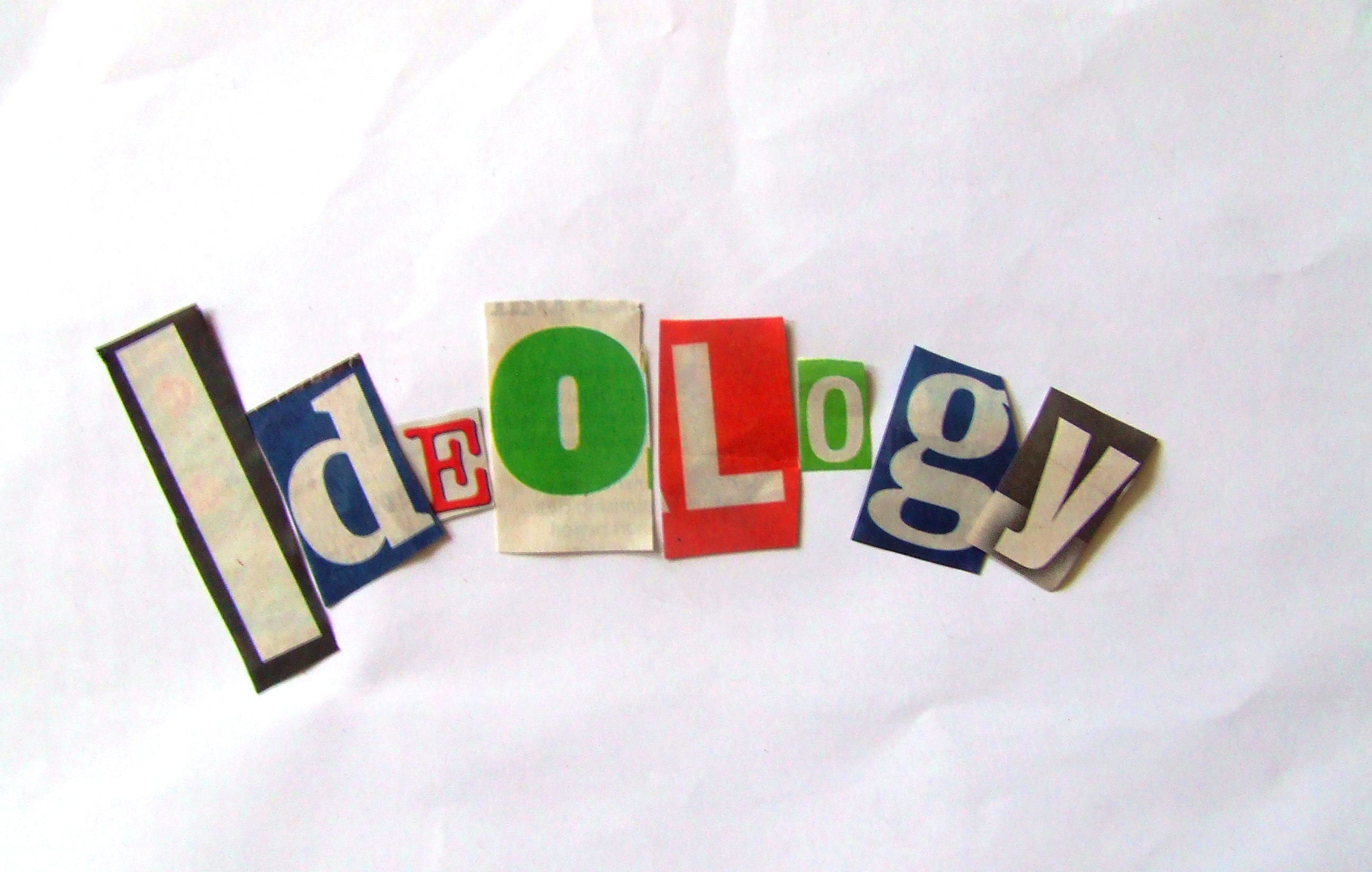
For me the most powerful part was the experience was that first half an hour watching the end of the durational piece. Now I am not sure if this was because it took me half an hour to absorb it, and half an hour for my head to fill with a number of responses, or whether I just got this piece more easily than the others. Perhaps I interpreted more, because I wasn’t rushing to try and interpret? I don’t know, but it was pretty special in there, and it did make me think: the repetition of the dance routines, the predictable formula of the music, the fact that the piece continued to be played out whether we were engaged directly or not, was for me quite a strong comment on the ‘apparatus of culture’ I also noted that by the end (not sure if it was intentional or not) that both performers had somehow synchronised which variants of coke they picked up to drink.. I wasn’t sure if this was deliberate but it made think how much of our consumer behaviour is learnt and imitated either consciously or subconsciously. I did leave the gallery thinking about the apparatus of culture in particular the media and it also triggered a memory of something I made myself years ago for an old uni module (seen below)

There was a question and discussion session at the end and now, I am kicking myself I didn’t stay – (was a bit worried that I may not understand it so bolted). On the whole I was really reassured that all the pieces seemed so accessible and the audience seemed to have a positive response (in fact one audience member rolled around on the floor at one point!- a small one 😉 It was great that it seemed quite a cross section of individuals/families etc. and it’s given me confidence to try out and watch more work of this kind. It was a memorable, and thought provoking experience which certainly made me question and think about cultural production and consumption. Looking forward to more from GetInTheBackOfTheVan soon.

Be present. Notice. Have a dream. Vitea Leadership in Action March 2011

Where are you going? – How will you get there? – Who will help you?

These are question we were asked at the culmination of an intense three days in Windermere, and what a three days it was.  Twice a year a combination of 60 students and research staff at various stages in their careers and spanning all disciplines, are selected to attend the free residential leadership courses on offer by Vitae the research training council. This year I was privileged enough to be selected for this prestigious course and  apprehensively made my way to the beautiful surrounds of Lake Windermere for what was a significant learning and existential experience.

Taking a ‘learning by doing approach’ the course was divided into seminars, practical workshops, and home group activities. Over the course of three days we were challenged to lead, reflect, learn, experience and work as a team. Whilst a variety of theoretical perspectives exist, a key emphasis of the course was experiential learning, and we were continually split up into changing teams and faced with various challenges. I ended up leading two tasks (one through delegation) these were managing multiple tasks and leading in a crisis. Multiple tasks was quite a challenge and we failed to achieve the full points. It was a little disheartening and the skills involved blindfolds, sculptures, quizzes etc etc.. Leading in a crisis was where I really felt I shone and we managed to perform well. We were assigned a buddy – often from a completely different background (mine was a middle aged, Chinese engineering professor from Oxford who had been sent on the course because he had poor relationships with his students) The buddy would then act as a ‘mirror’ and provide 360 degree feedback on performance and a sounding board for reflection.

A key learning point for the course was the power of failure. Most tasks were pretty difficult to achieve and through our efforts we encountered both obstacles and triumphs.  We were advised we would both succeed and fail spectacularly. This was appropriate. This did show me that there were still things to be gained from situations that turned out badly, that it wasn’t how many times you failed but how many times you got up again.

In addition to the workshop we were assigned a home group task. In groups of six were assigned the challenge of delivering a fund raising initiative in just three days. We were given the sum of £100 and told to devise and initiate a campaign for a charity of our choice.  All teams were to present on the final night, and were assessed against a range of criteria with a winning team being announced and prizes given.

I was lucky enough to have a great team, who worked hard to get our idea up and running. Having been assigned the team leadership role I was extremely proud three days later when our idea: Webber’s Windermere Womble’s – we were raising money for the organisation shelterbox,  and won the challenge overall out of ten other teams, (with the help of some litter picking efforts and the use of social media) Whilst we didn’t reach our target the sum of £320.00 in less than three days was a good effort and the highest total overall, and our concept made a contribution to both local and global needs.

I signed up for the course I guess because I was never sure if I had the power to lead others. Somehow I often ended up sort of leading people, but I had never really pushed myself forward consciously. The course was an intense, challenging and exhausting three days. However I learnt a lot about myself. The feedback helped me to learn that sometimes I know what’s in my head, but other people sometimes don’t.  It taught me to try and draw on others and trust people rather than always doing things myself. It also taught me that in teams people have different needs and not everyone responds well to my creative, energetic autonomous approach to leadership if they are happier with security, certainty and direct instructions.

It also showed me that there are lots of things about me that make me an effective leader. Like the ability to motivate and inspire others, to support and energise, to see the bigger contextual picture and to supply vision. Luckily I had people in my team with opposite skills to my own which is also what made us so successful I think. Fundamentally, and perhaps most significantly the course taught me about the power of collaboration. We were from different backgrounds, perspective, experiences, and often cultures. Yet we came together and achieved. That was probably the biggest lesson. Our team didn’t spend our start up money yet through teamwork we managed to create and succeed with our existing resources – people.

There a lot of people who are often closed minded to this sort of approach – workshops, integration, random tasks. It requires faith, trust and buy-in to get anything back from it, but if you do I’m sure you will think its worth it.  In fact it was a challenge in the first few days to convince my buddy professor to listen to me. He spoke often of how stupid his students were and how he was frustrated with them. After three days with me.. (stop sniggering at the back)  he actually began to reconsider the ‘youth’ of today in a different light..to think differently, and to appreciate the person behind the ‘student’ role. In turn he taught me that whilst being ‘old skool’ there was a lot of wisdom, commitments and dedication behind the communication struggles. He was a gentler person. So was I. Once the course was complete I took a few days in the beautiful lakes to reflect on the experience. The Wombles have since disbanded but I’m still in touch with a few of them.

So, three months down the line is the experience still with me? I think yes. The course taught me that I have leadership potential, but that I won’t get there on my own. I’ve been increasingly thinking about the possibility of social enterprise, and this is not something I would have had the confidence to consider before the course. It made me realise that my pre-occupation with the potential for failure actually often prevents me from achieving or producing things. Most importantly, however my PhD works out, I think the principles we learnt on the course are transferable enough to benefit multiple aspects of my life. Being a PhD student is not just about writing and defending a thesis. The course should me how much potential all of us had to lead inspire, achieve and support each other and to achieve for the good of society regardless of our disciplines.

It made me proud of the people that I met, and proud to also be one of them. One of the best experiences of my university career for sure.

More bodily contemplation – Bodies in Urban Spaces and the Bangkok Lady Boys….

So more bodily related tales… what else have I seen recently? An enchanting, magical and thought provoking experience…. bodies in urban spaces which ran as part of Mayfest is still very much fresh in my mind. The good thing about suddenly discovering ‘live art’ is that every experiences holds magic for me.

I met several people at Mayfest  that seemed to know it all. Everything about drama and art, everything about the industry, had studied everything for years or knew someone who knew someone who obviously knew everything.. Perhaps its the same with critics. You begin to build your expectations of what you want. Of what you think other people want. Of what is good and what is bad. . You stop seeing things with an open mind. Perhaps this is what happens to those that benefit from arts education. You are educated in the art of criticism and expectation. I have the distinct advantage of knowing very little about how to interpret things. I just well, use myself. For better or for worse. Raw. That’s all.

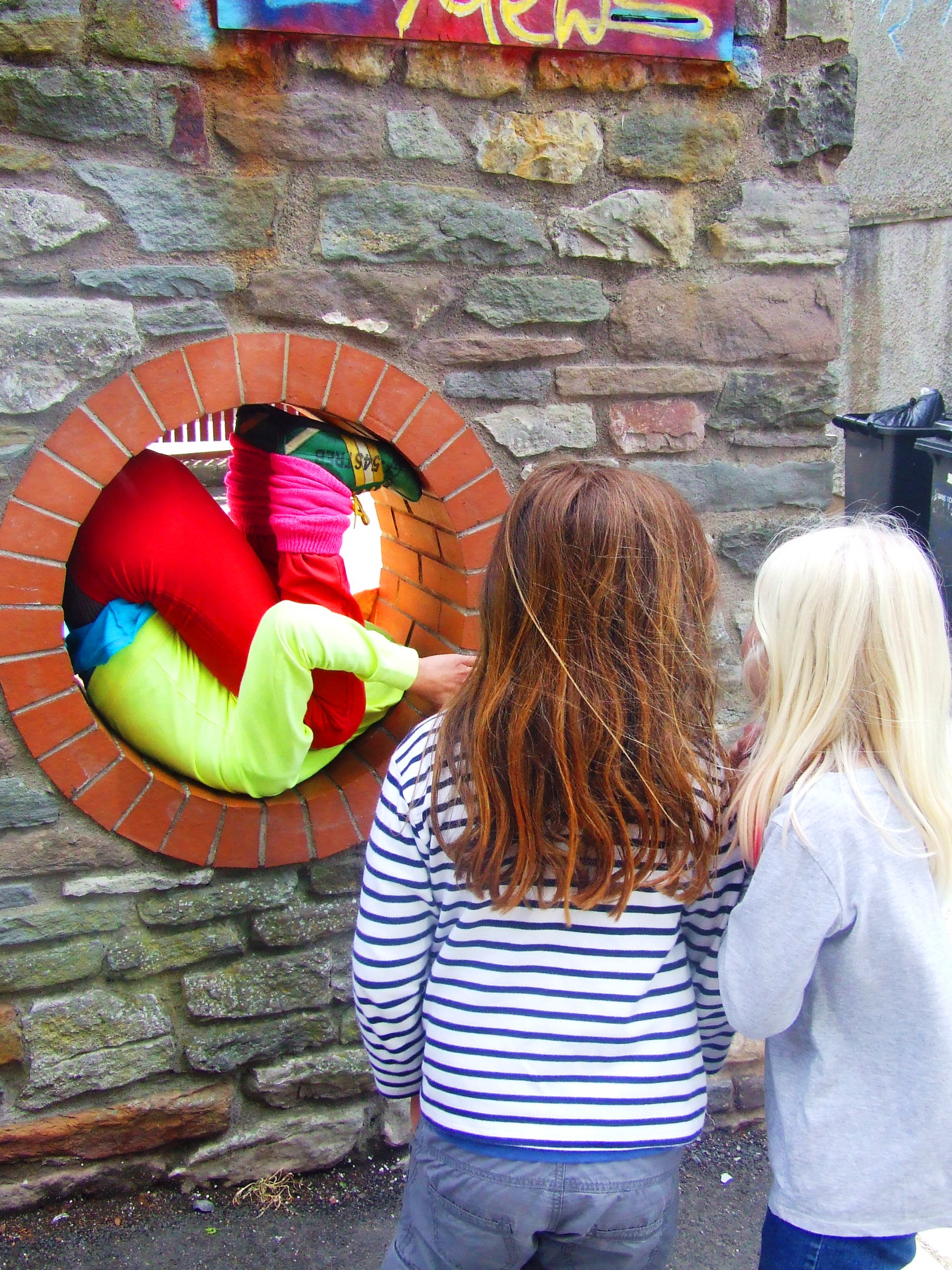
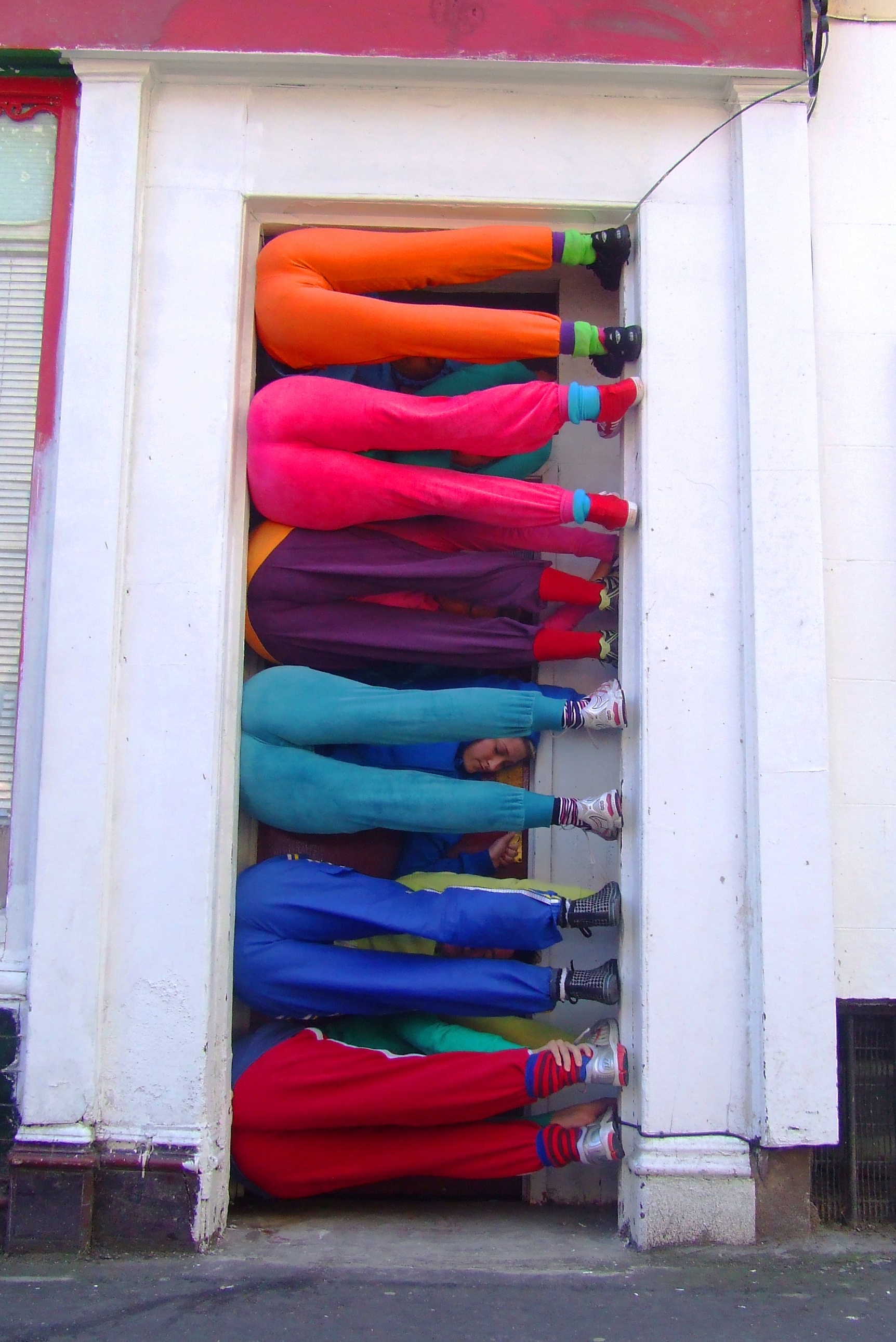
So what of these bodies. I had no idea what was in store. Meeting in Montpeiller park the ‘bodies’ (19 of them I think) clad in multicolour lycra and sweats ran ahead of us to take various positions as we walked through the city: Bus shelters, driveways, door frames. Whilst the agility, patience and amazing flexibility alone was highly impressive, one of the most powerful things of the experience for me was the running. As you passed one group of bodies the next would run ahead, within, around, through.

We were surrounded by neon elves. Magic ones. The traditional spatial boundaries were dissolved and new possibilities were created. Turn a corner, two bodies, colour. Was that a body? It didn’t really look like a body..? sometimes times it was a big pile of feet. Like a psychedelic caterpillar had keeled over and died. No end. No beginning. Just feet.

The trail took us to parts of the city I certainly didn’t know about.  Abandoned places, forlorn spaces. Where you wouldn’t normally look. Places you just didn’t notice.  Ugly places. Made beautiful and noticeable with bodies in them. The physical agility of the performers was commendable as it was surely a testing and trying spectacle to be part of. They look tried by the end. They squeezed. Strained. Squashed. Stood firm in doorways.

We started off a small group of spectators but finished as a crowd. It was magical. I wanted to cry when it was over.  It wasn’t really dance. It was kind of exhibition. But not. It didn’t feel like traditional devised theatre. What was it?

More photos of the day can be found here: http://tiny.cc/yxy86

I am rapidly coming to the conclusions that the best form of theatre is that which cannot be easily defined.

The memory will live with me for a long time. The body was the focus of the performance and a few weeks later I attended something quite different.. but again the role of the body was central.

Now. Here this. A performance by the Bangkok Lady boys is not something I would normally think about going to see..purely because I crave a deeper emotional experience nowadays..  I had seen them once before (the seats we were given were terrible) but my housemate offered me a free ticket (a corporate thing) so I thought I would go again.

The Bangkok Lady boys were to be honest a cut above your average drag act. The dancing was sharp. The production was high quality and high energy. The acting, mimicry and generally tomfoolery was suitable hammish and Benny Hill’esq. Stereotypes were enforced, jokes were crude. In general the audience loved it and paid on average a slightly high price for tickets, food and drink at the venue. It certainly seems to be a bit of a money spinner.

Now I’ve read a few reviews of the show since which have been entertaining, some positive in favour of what was admittedly, despite its crassness a jolly good show. Another which was a little disparaging of the performance on the basis that the author simply preferred women to men dressed as women.  This got me thinking: why do we go to see drag shows?

Fascination. People go to see drag acts simply to see the boundaries of physical normality moved. The Ladyboys, are more ladies than boys, in their looks, their movements their gestures. It was quite phenomenal how feminine and outright beautiful they looked, with the help of plastic surgery, corsets, feathers and an awful lot of max factor they were jaw dropingly gorgeous. You would rarely have thought they were anything other than women.

I’ts also a genuinely good laugh. If you don’t take it too seriously and can bear the political incorrectness which is prevalent throughout.  If I am honest, despite the fact these gender blurred bodies are painted, corseted and commodified, despite the fact the show is often cringeworthy in parts, despite the fact the miming is questionable and the tickets overpriced… I went to enjoy the dancing, and the big disco numbers, the feathers and the greasepaint..  but mainly I realise that in a world were the body is considered  as so important, and the idea of gender so often viewed as defined by sex, that to challenge these norms, to me is an act of bravery of the highest kind. To change your body to that degree is a significant feat, and whilst the bright lights and music perhaps make entertainment of these bodies, it maybe wise to question what it is like to be a ladyboy outside of the role. The humour makes things more comfortable to accept perhaps. At times it’s almost as if  it’s a strange kind of revenge over the audience as the most stereotypical alpha male is dragged up on stage and humiliated. Feel uncomfortable in the audience boys? Is that not the idea?

When comparing the two performances, the Bangkok Lady Boys do not come out on top. Next to anything that Mayfest produced  it’s like comparing apples and pears. However, I conclude that any person, a man or women, has a right to perform their art to whatever degree they wish. We live in a society where the body is situated as fundementally so important, and my final thought is this:  The Lady Boys have, as individuals, each been  compelled to redefine who they are both physically and mentally to a significant and life changing extent. Following this, they are also brave enough to stand on the stage in celebration of their choices. So it is this, in my opinion, is something that always deserves my applause… Good on’ em.

Writing on the body at the Arnolfini

In January I bravely signed up for ’Writing on the Body’ . Led by Dr Barbara Bridger from Dartington College of Arts, a two day workshop at the Arnolfini. I’m from a social science/studies background, and I was curious to understand what the arts could offer in terms of cultural theory and interpretation of this notion of ‘the body’. I’d previously studied as part of my first degree the sociology of the body and I was interested in thinking about ageing bodies is in relation to my research. I was hopeful that the course would perhaps stimulate my thinking in a different way. So. Being brave. I wandered quite naively into the room ever the optimist.

There was some background theory – some basic Derrida which was great and a reminder of how despite how disciplinary boundaries may be defined – fundamentally the thoughts and thinking of key theorists along with political, social and cultural changes often permeate the teachings of both the social sciences and the humanities. Although there may be some way to go before philosophy dribbles into the teachings of pure science though? Or maybe not?

It was a good workshop. Scary but good. I was introduced to a range of textual practises and ways of writing for the body. To be fair I hadn’t anticipated the amount of practical work we were expected to do. This element was totally new to me.  Not being an artist or at least not being anything like one for a number of years I was totally unprepared for the level of self exposure (maybe not the right word – maybe self expression) that the practical element expected. Suggested practical tasks were things such as: photographing your body and using post it notes to tell a story of you (such as scarred bodies), writing the story of a body part on a piece of paper and burning it, or making an artwork using your own bodily fluids (the tutor re-laid a story of one of her former students cutting herself during a performance. We were not specifically encouraged to do this but I got the distinct impression that the tutor sort of maybe felt that the student concerned was within her rights to do so.  Interestingly I had also heard a rumour through drama students at my current university that a similar thing had occurred during a performance for an avant-garde module, and the result being the performance was stopped.   This raised an interesting ethical dilemma for me, I have not seen enough theatre to comment on any specific performance but in terms of pedagogy – where do you draw the line?

The body is a form of expression not just in performance but in everyday life – through the embodiment of physical actions with signifying meanings, through conscious self expression or display (tattoos, hair dye, piercings, cosmetic surgery etc) and the ongoing societal struggle and scientific quest to halt or delay the ageing process. Bodies are places of struggle, they are canvases and are often key signifiers to others of our place in society – disabled bodies for instance. What is *normal* v’s what is *different*  what is our attitude to live bodies vs dead bodies? Where does the person end and the body begin? What is viewed as more preferable old body or a young body? Why?

We also go the opportunity to look around the exhibition on the same theme which had some breathtaking exhibits, which certainly made you think about the body in a different way. It was a great experience for me to go round in a group and discuss responses to the pieces as I I’ve often no idea really (or felt a little bit of a luddite) sometimes around visual modern art. I’m getting there (I seem to be better with sculpture than paintings in this respect).

What I did notice sadly though was the absence of ageing related exhibits, examples and theory in both the literature, the workshop and the exhibition/examples we were shown.   So whilst this issue of the body appears to be alive and well in sociology and the arts, the issue of ageing has yet to be explored or represented thoroughly perhaps in both disciplines.. and ageing and transport? Nonexistent.

I’ll give it a go.

I didn’t get around to producing any practical pieces, and I was unable to attend the second day as I had a rehearsal. I was also really rather glad of this, to be honest I was terrified.  But perhaps I will revisit that list at some point. I have had a few ideas since then (mainly relating to the commodification of the body) that I could explore.

Another thing that struck me was how overwhelmingly introverted or (can I say it) navel gazing I felt it was… I guess my attitude has always been that any inner turmoil is (was) what it is, but there is always a worthier story to tell than mine. A bigger cause than any anecdote about my own suffering. Perhaps I just wasn’t angry enough?  Take Tracy Emin. She has suffered. She has produced some great art. But blimey O’Riley sometimes I just think ‘get over it’. Perhaps the subject is not her. I sort of think it is though? It seems epistemological (subject/object?) debates are central perhaps to artistic production and interpretation just as they are in qualitative research.

Similarly my in research, there are some authors who,  using ethnography, have endeavoured to reveal the nature of transport spaces through observations, but ultimately what I hear in the final write up is the voice of the researcher, not the observed. Is it not more powerful to give voices to others to enable them to tell their own stories? I don’t know enough about art or performance yet to answer these questions (both why and how) but at least for research to a greater degree as possible, the story is about them, facilitated by me. I will never be able to truly understand the meanings associated with older people’s experiences and how these experiences affect and impact on them both physically and psychologically, but I can attempt to find a way to reveal the stories of the people I meet if it is simply not possible to empower them to tell their own.

Getting stuck in.. experimental art at the Folk House

Okay so this is all a bit experimental..  I enjoy collage, photography, and other art things but fine art I am a complete novice at.. its all a bit of a learning process.. Most of my efforts go into photography and I hope to launch  a dedicated website  in January of 2012 so a good deal of my photos will be availiable then, to view and buy. In addition I’m becoming increasingly interested in the potential of video and moving image as forms of creative expression, documentary and idea dissemination. However I decided to branch out recently in a painting day for my birthday treat for myself

Here are the (best) fruits of my labour and a few other arty type things I’ve  got up to recently..

Painting 

The paintings below I produced whilst messing about recently on a introduction to painting course at the Folk House in Bristol. My basic strategy was just to create something and try to work out what it all meant after.. the meanings are there but I found it doesn’t help for me to think about them consciously.. not sure if that is common in art or not.. It was very daunting to walk into what felt like a classroom for the first time in years and pretty scary to be given a range of blank sheets to work with. The course was reasonably flexible and we could more or less interpret things in the way that we wanted.. I struggled a bit with my total lack of drawing ability but found I am much more comfortable using colour and texture.  In the end it was a great birthday!

Entitled: The Patriotic City

Another effort…

Entitled:  Lotus Flower

Published Photography

Realised I took the below photo in 2009 and  it has recently been featured in the book Bandstands by Paul Rabbits.

Entitled: Clapham Common in snow

Collage

The below is a collage I put together to assist in songwriting, for a course I took at Artist Studio’s Bristol earlier in the year  (the collage is much better than the song turned out to be). I am currently about to start work on another collage piece called ‘The Commute: parts 1 and 2’ which are based on, and in response to a poem I read recently.

Entitled: Six impossible things before breakfast

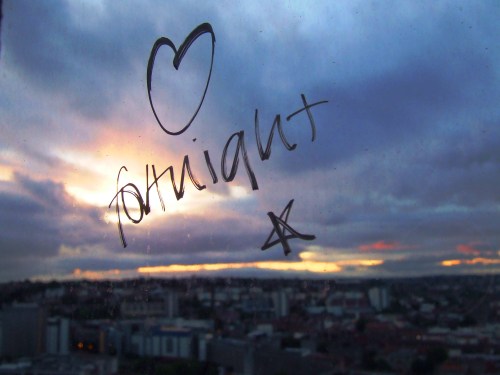
Something lovely came to Bristol.. Mayfest’s ‘Fortnight’, creativity and new beginnings.

Brought to Bristol by Proto-Type Theatre, from the outset the Fortnight project required something of a personal leap of faith:

Something poetic, beautiful and strange is coming to Bristol.
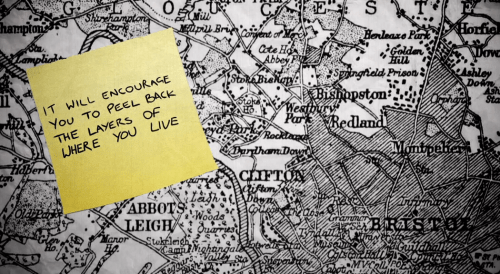
It will encourage you to peel back the layers of where you live.
To look for secrets
Surprises
To meet someone new.
Or hide in a crowd.
On 2 May, Fortnight comes to Bristol.
And you are invited…

For someone who had never attended or been involved with a production incorporating direct participatory audience engagement or ‘live’ art, I was a little apprehensive yet excited at the prospect of my first Mayfest experience. Having been fascinated if a little overwhelmed by the Arnolfini workshop ‘writing on the body earlier in the year, I was ready to once again dip my toe into the unknown in spite of the fact I originally felt like something of an inadvertent artistic philistine.  Whilst the concept of an interaction which was ‘beautiful, poetic and strange’ was appealing, for me, the Fortnights project’s main attraction was the promise of the exploration of place and the opportunity to find greater meaning.  On a few weeks break from my PhD research on doctors orders I figured that I really didn’t have much to lose in taking part (apart from the £15.00 ticket fee) but also admittedly didn’t really have great expectations as to what was to come.
Mysterious beginnings

Fortnight began with a mysterious personalised handwritten letter delivered at midnight, containing a felt badge and instructions as to the next day’s events. The following two weeks unfolded almost moment by moment. Everyday a new location to explore coupled with interactive media based tasks that required us to think, imagine, remember, see, appreciate and reflect on both Bristol as a place and on our on our own reactions to the activity and the resulting thoughts and feelings. Philosophical prose was emailed daily, along with beautiful poetry. A visit to the fountains revealed hundreds of yellow rubber ducks bobbing happily (ours for the taking).  We were encouraged to participate as much or as little as we wished, to play, to create and contribute through film, sound, and visual art, and tweet our comments anonymously on the shared fortnight twitter page, as well as receiving and conversing daily through text messages and emails with the mysterious ‘Fortnight’ who after such regular, personal and often individual contact the absence of which left something of a void after the project came to an end. Taking themes such as space vs. place, nostalgia, the daily commute, spirituality, time,  and meaning , participants were encourage to explore the city both physically and temporally discovering new secrets, hidden places, ourselves and quite often each other. Cumulating in a final group goodbye on the 17th story floor of Castlmead the participants were treated to a spectacular 360 degree view of the city, a party buffet and media presentations of the individual and co-produced contributions that had been made – all of this without  any assistance from the secret Fortnight hosts.  Who continued in the typical fortnight guise of being virtually present, yet corporeally absent.

Writing this now a few weeks after the fortnight project finished I am still a little lost for words in actually defining what Fortnight was and adequately describing its impact and value.  On reflection I came to few key areas of significance that either stood out and I took away with me the following thoughts and contemplations from my experience.

It’s performance Jim, but not as we know it…

As the days went by, there was a continual ongoing debate amongst participants as to what the Fortnight experience actually was and how it could be defined.  The project was in fact so many things.  It was ‘live art’ although I would argue that this was co-creation of performance rather straight audience participation (in my head there is a difference between these two concepts but I’ve no idea if it really exists or if my explanation communicates that well..) but the experience also simultaneously contributed to social, economic and community development as well as having an environmental agenda.  For example the *trail* led us to mostly free, important and perhaps under used resources – a church, a local independent cafe, public spaces and parks, museums and collections, and on the way we passed  local exhibitions and information for local creative support networks, casting offices, records offices, and other various places that may help us on our individual artistic journey.  Additionally some of the tasks may have also passed comfortably as public consultation techniques on the notion of place and the city, and the ‘council planner’ in me would have been interested to see the full list of  opinions on ’non-places’ and the reasons for living in Bristol that were identified by some of the participants.

So on a practical note it seemed to be contributing a wider benefit other than just on an individual psycho-geographic level.  Whilst it was very much an individual experience on one hand, the interaction amongst participants strengthened knowledge of local resources, senses of local and personal  identity  and community ties (having completed the project 30 people signed up to a facebook group in a bid to keep the communitas and creativity going). It also was a great incentive to walk and got participants exercising, as people explored the city from location to location each day. My feet were sore on more than one occasion.

The project has been an excellent demonstration of the opportunities of art in a community setting and how it can be applied to the benefit of others. My previous knowledge of art was not extensive and to be honest I may have secretly thought that at time it could be a little elitist and a bit self indulgent so the power of it and its possibilities I didn’t really appreciate before.  So perhaps rather than trying to define what in fact Fortnight was I was left with a broader question:  What is art? and who is it for?

Whilst I have few criticisms of the project, we should allow for context to a certain extent. Mayfest was an ideal platform from which to launch the project and Bristol of course already has a strong cultural identity and arts scene.  If the aim of the project was to continue to try and reap some of these broader community benefits, It would be interesting to see if the success of Fortnight could be repeated in other less ‘desirable’ or overtly ‘arty’ cities.


How does technology change the way we relate to self and other?  

A key point to the experience was the projects reliance and use of pervasive media.  This made the experience more ‘magical’ in one sense but also highly personal in another. The *challenge* or key thinking point for me was the role that technology plays in human communications and its impact on relationships. It was surprising how quickly I became used to, and looked forward to the daily communication via email and text and how despite trying not to, my ‘Fortnight’ represented  a person I had connected to. Perhaps my connection with Fortnight was that of a literary lover who wrote beautiful heartbreaking poetry, or a friend or parent who encouraged my creative endeavour. Either way it got me thinking about the role of technology and the distortion, interpretation or enhancement of human connection – virtual, imagined, temporal or not.

The consequence of these communications was also something that I thought about. What happens once the text/email/tweet/blog is out there, broadcast or published and you are unable to take it back? Do es the potency and meaning of the message change over time or is captured and kept for as long as the message exists in its virtual domain?

Creativity and play in artistic recovery, innovation and everyday life

So on to the most significant aspect of the project for me.  The role of play and outright silliness in the development and production of creative ideas.  Here I think it’s important to define the difference between ‘art’ and ‘creativity’.  Or is it? Oops have I come back to the ‘What is art question again?’  Artists of course, need to be creative and to create, but engineers also need to be creative to design, social scientists need to be creative to solve problems, to an extent creativity is necessary for everyday life, whether for problems solving, self expression or sharing with others.  So perhaps another lens to look on Fortnight, the *art* of fortnight is its facilitation of creativity amongst participants regardless of background. The emphasis on art that does not/should not take itself to seriously was in my opinion one of its strengths.. especially (can I say it?) at a festival like Mayfest. Brilliant productions. But how accessible are they to a wider audience? Is a wider audience welcome at such a festival?  Should it be encouraged? (Just asking the question)

Fortnight was both empowering and grounding, and a reminder that even the most highbrow/contemporary artistic ideas or productions often started off with a rubber duck in a bath (and nobody should ever be too *arty* or educated or experienced for a duck bath. No. No. No)

A further question that struck me was:  Who is the artist? Is the four year old child drawing on the wall with crayon an artist? Is the student an artist? or is an artist made when her peers agree her work is significant or when she secures her first commercial commission/role?  Perhaps there are different debates depending on how you look at it. For me. I decided that creativity realised in any sense no matter what scale, equals art in whatever form – and that is all.

Conclusion – I’ve been wearing my pyjamas for the past 100 years…

Oh okay, so 100 years is a bit of an exaggeration, and they are metaphorical pyjamas of course… but my key conclusion is thus..  On reflection, prior to the project I did feel like I had been sleep walking through life.. Fortnight promised to peel back the layers of where we live revealing new meanings and hidden secrets, and it did just that. In addition it gave me new confidence to create, embrace the potential of technology, removed my block, got me out of the house, renewed my appreciation of where I live and my sense of identity and place. It created new lasting social networks in my local community.  Fortnight reminded me that Bristol represents a city of possibility if only I can retain my sense of being present long enough to notice it. It was a potent reminder that when your expectation is to create rather than to achieve, you have nothing to lose and everything to gain.

And so to the future.

After such an experience what next? I decided to set up this blog. To tweet with other artists and pester them nicely in the hope that I will learn things.  To see my new friends regularly. To consolidate my creative endeavours and remember possibilities I had long since buried. To apply the principles I had been reminded of to my everyday life and improve my efficiency at work. To make a plan for the future.

So that’s it. My first blog entry , dedicated to the Fortnight project…

Lovely.

Oh and one last thing… As long as you do understand of course… that I do realise, that, at the end of the day – it was just a project, right?

You know – an arts project?

Because magic….Magic doesn’t really exist.

Does it?